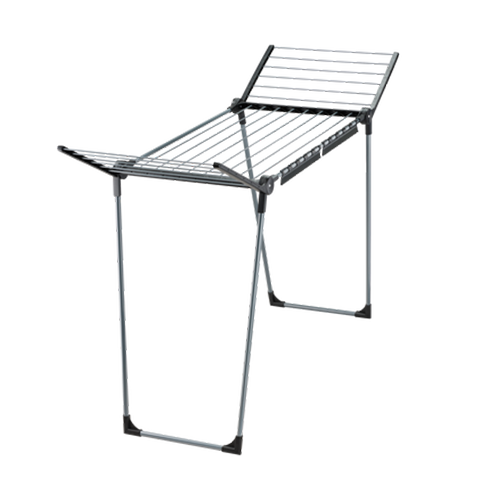


This part of the range includes free-standing drying racks from Leifheit. These are freestanding models where the drying space is built into the rack itself, so the solution can be placed where needed in the home. If you want to see more products within the same area, you can also view the full range of drying racks or go to the wider home care section.
On a webshop page like this, the category helps you move from a broad product type to a more specific construction. Instead of comparing all drying solutions at once, you can focus on free-standing models only and then look at how the drying space is arranged. This makes it easier to sort between a classic Leifheit clothes airer, a tower clothes airer or a Leifheit pop-up clothes airer, depending on the shape you prefer.
If you are browsing across related product groups, the broader page for drying racks and accessories gives you an overview of the full product area. From there, it becomes easier to narrow your choice based on whether you want a freestanding solution or another type.
Although the products belong to the same category, they are not built in the same way. A standard free-standing drying rack usually has a more traditional shape. In this type, the drying space is generally spread more horizontally, which gives it a different layout from taller models.
A tower clothes airer is built upwards with several levels. This means the drying space is gathered more vertically, which sets it apart from wider constructions where the available space is distributed across the width. If you are comparing shapes within the category, a clothes airer tower is therefore a clear alternative to the more traditional format.
Because tower models use height as part of the design, they stand out as a separate direction within the selection. When browsing the category, users often compare a Leifheit clothes airer tower with broader racks to see how the drying area is arranged rather than simply how much space the rack takes up overall. This makes the structure of the rack one of the most useful ways to sort the options on the page.
A pop-up clothes airer has a different form again. The name points to a solution that folds out and folds together in a more compact construction. In everyday use, this gives the category another distinct type to compare with both classic free-standing racks and tower models. A Leifheit pop-up clothes airer still belongs to the same overall group, but the construction differs clearly from the other formats.
For most situations, a practical way to choose is to start with the overall shape. Some users begin with a classic free-standing model because they want a familiar layout. Others focus on a tower clothes airer because the drying space is arranged over several levels. Others look first at a pop-up clothes airer because the compact construction is the main point of difference. In all cases, the category helps you compare the products by form before you move on to individual models.
What the models have in common is that they stand freely and are intended for indoor use. That shared feature is what keeps classic racks, tower designs and pop-up designs together in one category, even though their constructions differ in clear ways.
When users explore free-standing drying racks online, they often start with the broad choice of whether the rack should stand on the floor or be fixed in place. Once that has been narrowed down to freestanding models, the next step is usually to compare how the rack is built. This category supports that process by gathering the relevant Leifheit products in one place and separating them from wall-mounted and other drying solutions.
Within the page, the most useful comparison points are the same ones described in the product types themselves: whether the rack has a traditional shape, whether it is built in height as a clothes airer tower, or whether it folds into a more compact pop-up construction. This makes the category practical for users who already know the type they want, and also for users who are still comparing the basic layouts.
If you typically begin with a brand-specific search, terms such as Leifheit clothes airer and Leifheit clothes airer tower fit naturally into this category, because the selection here consists of Leifheit models only. If you are instead exploring by construction, the category still works as a clear filter because it groups the products by the way they stand freely and by the way the drying space is distributed.
Another helpful way to browse is to move between the broad product group and the narrower subcategories. The page for drying racks gives a wider view of the available types, while this page keeps the focus on free-standing versions only. This makes it easier to compare within one format before looking at alternatives elsewhere in the range.
The focus here is on racks that stand freely on the floor. This is what separates them from wall-mounted drying racks, where the solution is fixed in place rather than standing independently. If you are deciding between these categories, the first distinction is therefore not the exact shape of the drying space, but whether the rack is freestanding or mounted.
Once you know that you want a floor-standing solution, the next comparison becomes more specific. In this category, the differences mainly come down to the form of the rack and to whether the drying space is arranged more across the width or more in height. That is why classic free-standing racks, tower designs and pop-up designs can be compared meaningfully within the same listing.
If you are looking across the full product area, it can also be useful to visit accessories for drying racks alongside the main rack categories. This helps when you want to stay within the same overall area of the webshop while moving between the different parts of the assortment.
From a navigation point of view, the structure is straightforward: the wider home care section leads into drying racks and accessories, then into the broader drying racks overview, and finally to this category for free-standing models. That path mirrors how many users narrow their search: from a general household area to a product group, and then to a specific construction.
Seen that way, this category is useful both for users who already know they want a free-standing drying rack and for users who are comparing the different ways drying racks are built. The key differences are not hidden in technical details, but in the visible construction: traditional free-standing layouts, vertical tower arrangements and compact pop-up forms. Keeping those directions together makes it easier to compare the range and choose the type that matches what you are looking for.
A free-standing drying rack is a model where the drying space is built into the rack itself and the rack stands independently on the floor. In everyday use, this means that you can place it where needed in the home rather than using a fixed mounted solution.
A practical way to choose is to start with the overall shape of the rack. In practice, this helps you compare whether you prefer a traditional horizontal layout, a tower clothes airer with drying space arranged over several levels, or a pop-up clothes airer with a more compact fold-out construction.
A classic free-standing drying rack usually spreads the drying space more horizontally, while a tower clothes airer is built upwards with several levels. This makes it easier to compare whether you want a wider layout or a clothes airer tower where the drying area is arranged more vertically.
A pop-up clothes airer has a construction that folds out and folds together in a more compact form. In everyday use, this means that it can be compared with both classic free-standing racks and tower models based on how the rack is shaped and how the drying space is arranged.
No, the main difference is that free-standing drying racks stand on the floor, while wall-mounted drying racks are fixed in place. In practice, this helps you first decide whether you want an independent floor-standing solution or a mounted type before comparing narrower options.
It helps to begin by narrowing the choice to free-standing models only and then compare how each rack is built. This makes it easier to sort between a classic Leifheit clothes airer, a Leifheit clothes airer tower or a Leifheit pop-up clothes airer based on form rather than looking at all drying solutions at once.
They are grouped together because they all stand freely and are intended for indoor use, even though their constructions differ. In practice, this helps you compare the main formats in one place before moving on to individual models or other filtered choices.
A useful approach is to move from the broader drying rack area to a more specific selection for free-standing models, and then compare the overall shapes. This makes it easier to see whether a traditional layout, a tower design or a pop-up construction matches what you are looking for.