
A sharp selection of strong and practical herb knives
In a well-equipped kitchen, a good herb knife is one of the tools that gets used again and again. Its short, sharp blade makes it suitable for smaller ingredients and tasks where control matters. In this category, you can compare Herb Knives across sizes and designs, making it easier to narrow your options based on how you typically work with fruit, vegetables and herbs. If you want to explore more broadly first, you can also view our full range of kitchen utensils and our wider selection of kitchen knives.
Our range includes Herb Knives from brands such as Morsø, Lion Sabatier and RÖSLE. Across the selection, you will find knives that combine sharp functionality with a durable and carefully finished look, so the category gives you a clear overview when you want to compare different styles within this smaller knife type.
What is a herb knife?
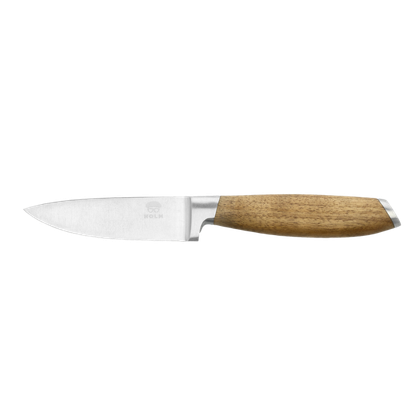
A herb knife is defined by its short, sharp blade and comfortable handle. Its compact format gives you a high level of control, which makes it especially useful for kitchen tasks that require precision. That combination of size and handling is also why many people reach for this type of knife several times during the day.
What is a herb knife used for?
Herb Knives are particularly effective when working with herbs, vegetables and fruit. The blade is made for smaller slicing and cutting tasks, where a neat cut and controlled movement are important. In everyday use, this makes the knife suitable for jobs where larger knives can feel less precise.
If you are building a practical setup for preparing vegetables, it can also make sense to combine smaller knives with a vegetable peeler. A practical way to choose within this category is to think about whether your knife will mainly be used for trimming herbs, peeling fruit or handling smaller vegetables, as that will guide you towards the size that feels most natural.
How to use a herb knife
The practical size of a herb knife makes it possible to work with both the ingredient and the knife in your hands at the same time. With a smaller knife, you often get more control and more flexibility, because fruit and vegetables are easier to turn and angle, so you can guide the sharp blade where you need it.
When you are working with larger vegetables, it is often more practical to use a cutting board so the ingredient can be held steady while the blade moves through it. For most situations, this is also a useful way to think about size: the smaller herb knives are often easier to use in the hand, while the larger ones are better suited to ingredients that are handled on a board.
In our selection you will find Herb Knives in several sizes, including 9 cm, 10 cm, 12 cm and 13 cm. That difference matters when you compare products on the page. The smallest sizes are easy to manage when the knife is in one hand and the ingredient in the other, while the larger sizes give you more blade length but can feel less nimble for that same type of work. For many, it is therefore useful to have at least two Herb Knives in different sizes, depending on the task.
If you are comparing several knife types at the same time, it can also be helpful to look beyond this category. For broader everyday tasks, many users also consider chef's knives or santoku and nakiri knives, while complete assortments can be found under knife sets.
Do you know the mezzaluna?
Herb Knives are versatile, but very fine chopping can be challenging for this knife type. For that kind of task, a mezzaluna is designed to make the movement easier. Its rounded blade creates a rocking action that works effectively for slicing or chopping herbs and vegetables. This can be a useful comparison point if you are choosing a knife specifically for herbs rather than for general small cutting tasks.
There are also electronic solutions for chopping, but within knife categories it is helpful to understand where a herb knife performs best: controlled cutting, trimming and peeling rather than dedicated chopping.
Do you know the tomato knife?
The sharp, smooth blade of a herb knife can be challenged by porous fruit and vegetables such as tomatoes. A tomato knife has a serrated edge, which makes it easier to break through the smooth skin. If you often prepare ingredients with delicate skins or soft interiors, this is a useful point of comparison when browsing different knife categories.
Other specialised knives can also be relevant depending on the ingredient and the task. For bread with crusts, you can compare with bread knives. For serving and slicing cooked cuts, there are carving knives and sets. For fish preparation, you can look at fillet knives. Looking across these categories can make it easier to decide whether a herb knife should be your main small knife or part of a broader knife collection.
How to care for your herb knife
A good herb knife is a sharp herb knife. To keep it in good condition, proper care and maintenance are important. When users compare knives on a webshop, materials and appearance often get the most attention first, but care is just as relevant when deciding which knife fits your kitchen routine.
Cleaning
Always wash your herb knife by hand with washing-up liquid and warm water. It should not be cleaned in the dishwasher, as this wears down both blade and handle. This is especially important if you choose a knife with a wooden handle, as the wood can be damaged.
Dry the knife straight after cleaning so moisture does not remain on the handle for too long.
Maintenance
Sharpen your herb knife regularly with a knife sharpener to help maintain its sharpness. It is also a good idea to avoid using the knife on very hard surfaces, as this can damage the cutting edge.
If you are comparing equipment around your knives as well as the knives themselves, maintenance tools are often a natural next step after choosing the knife type that suits your tasks.
Storage
Store your herb knife in a knife block or on a knife magnet, where the blade is protected from knocks. It is best not to place the knife loose in a drawer, as movement against other utensils can damage the blade over time.
With the right care, a herb knife remains a reliable kitchen tool for years. A little attention makes a clear difference to how well knives keep their function and appearance over time.
Find the right herb knife for your kitchen
When you browse this category, a practical way to choose is to start with blade size and then compare design, handle feel and the tasks you expect the knife to solve most often. Some users begin with a herb knife and then build out their collection with other knife types, while others compare this category with larger all-round options first.
Alongside Herb Knives, you can also explore other kitchen knives to see how this smaller knife type fits into a broader selection. That makes it easier to decide whether you need one precise knife for daily prep, a set of different knives for varied tasks, or complementary storage and sharpening tools to complete your setup.
Frequently asked questions
What is a herb knife used for?
A herb knife is mainly used for smaller cutting jobs involving herbs, fruit and vegetables. In everyday use, this means it helps you make neat, controlled cuts where a larger knife may feel less precise.
How do I choose the right herb knife size?
A practical way to choose is to think about whether you usually work in the hand or on a cutting board. In practice, smaller sizes such as 9 cm or 10 cm can feel easier to control for trimming and peeling, while larger sizes such as 12 cm or 13 cm give you more blade length for ingredients handled on a board.
Why does blade size matter with herb knives?
Blade size affects how nimble and controlled the knife feels during use. In everyday use, this means a shorter blade is often easier to manage when holding the ingredient in one hand, while a longer blade can be more practical for slightly larger vegetables on a board.
How do you use a herb knife in everyday cooking?
A herb knife is designed for controlled work, especially when you need to trim, peel or slice smaller ingredients. In practice, this helps you guide the blade more precisely, and for larger vegetables it is usually more practical to use the knife on a cutting board.
When is a mezzaluna a better choice than a herb knife?
A mezzaluna is better suited to very fine chopping because its rounded blade is made for a rocking motion. In everyday use, this means it can make chopping herbs easier, while a herb knife is more suitable for controlled cutting, trimming and peeling.
When should I use a tomato knife instead of a herb knife?
A tomato knife can be more effective for tomatoes and other soft produce with delicate skins because its serrated edge breaks through the surface more easily. In practice, this helps you cut cleanly without pressing too much on the ingredient, which can be harder with a smooth herb knife blade.
How should I clean and maintain a herb knife?
A herb knife should be washed by hand in warm water with washing-up liquid and dried straight afterwards. In practice, this helps protect both the blade and handle, and regular sharpening with a knife sharpener helps maintain a good cutting edge.
What is the best way to store a herb knife?
It is best to store a herb knife in a knife block or on a knife magnet so the blade is protected from knocks. In everyday use, this makes it easier to keep the edge in better condition than storing the knife loose in a drawer with other utensils.