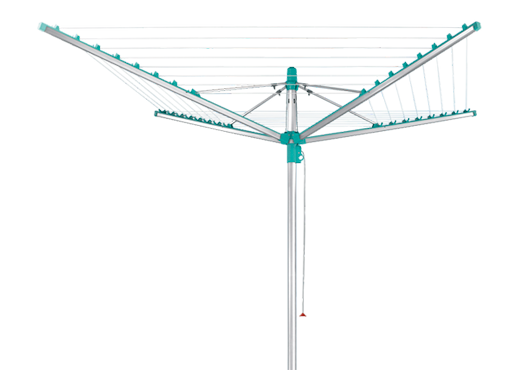

Outdoor drying racks cover everything from classic rotary drying racks to retractable washing lines and wall-mounted models. What they have in common is that they are made for drying laundry outdoors, but they differ clearly in shape and setup. A rotary drying rack usually has a central pole with arms and several lines arranged around the frame. A retractable washing line is a simpler solution where the line is pulled out between two fixed points. Wall-mounted drying racks for outdoor use are installed permanently and take up less space when not in use.
If you want to explore the wider area of drying racks and accessories, outdoor models are part of home care.
The main difference in this category is how the drying rack stands or is mounted. A rotary drying rack for outdoor use is a free-standing solution that is often used in the garden or in an open area where there is space around the rack. Here, the drying lines are grouped in a circular or square structure around the centre. That gives it a different use from an outdoor washing line, which depends more on a wall, post or another fixed mounting point.
A retractable washing line suits places where the solution should be stored away between uses. That sets it apart from wall-mounted drying racks, where the rack itself is the fixed structure. If you want to compare that type more closely, you can also look at wall-mounted drying racks.
A rotary drying rack is typically the most distinctive option in this category because it brings together a large amount of drying space in one structure. It suits outdoor use when you want a dedicated place for drying several textiles at the same time. If you are specifically looking for a rotary outdoor drying rack, this is the type of construction to focus on.
An outdoor washing line is a simpler and less visible solution in use. Here, the focus is on line drying between points rather than on a complete rack. A retractable outdoor washing line can be relevant when space is limited or when the solution is only needed from time to time. A wall-mounted outdoor drying rack sits between the two types because it is both fixed in place and more compact than a free-standing rack.
For users browsing a webshop, a practical way to choose is to start with the type of setup. If you want a structure that stands on its own, outdoor models in this category can be compared with free-standing drying racks. If you already know that the rack will be attached to a wall, it is easier to narrow your choice by looking at wall-mounted options and then comparing their form and placement.
When comparing products in this category, many users start by deciding whether they need a free-standing, retractable or fixed wall-mounted solution. That first step helps sort the category by the way the product is used and installed. From there, it becomes easier to compare how much drying space each type provides and how visible or compact the setup is when not in use.
For most situations, the category works best when you move from broad product type to more specific details. A rotary drying rack stands out because of its central pole and surrounding lines. A retractable line stands out because the line can be extended only when needed. A wall-mounted rack stands out because the frame itself is attached to the wall. These differences make it easier to compare products that may all be intended for outdoor drying but do not solve the task in the same way.
If you are browsing across related categories, this page sits within the wider selection of drying racks and accessories, where outdoor options can be compared with other drying solutions.
Space and placement are often the most useful points of comparison in this category. A free-standing rotary drying rack generally needs open space around it, which makes it relevant for a garden or another outdoor area with room for the structure. A retractable line depends on two fixed points and can be a better fit where a more discreet setup is preferred between uses. A wall-mounted outdoor rack stays attached in one place and takes up less room when folded away or not in use.
If you typically compare categories by installation type, this helps you narrow the selection more quickly. Some users begin with the place where the drying solution will be used, such as a terrace, garden or outside wall, and then move to the form that fits that location. Others begin with the product type itself, such as a rotary rack or retractable line, and then compare where it can be placed. Both approaches support clearer product comparison on a webshop page.
Outdoor drying racks are part of a broader home category, and if you want to move one level up while comparing options, you can browse home care for the surrounding selection.
Some users come to this category knowing they want an outdoor drying solution, while others are still comparing nearby options. If you need a fixed wall solution, the separate page for wall-mounted drying racks gives a more focused view of that type. If you want to compare outdoor models with other stand-alone formats, free-standing drying racks is a useful next step.
If you are looking for parts or practical additions rather than a full rack, you can also see accessories for drying racks. That can be relevant if your comparison starts with an existing setup rather than a new drying solution.
Across the category, the key is to compare type, placement and construction in the right order. That makes it easier to move from a broad overview of outdoor drying racks to the specific solution that matches the way you want the rack or line to be positioned and used.
A rotary drying rack is a free-standing structure with a central pole and lines arranged around it, while a retractable washing line stretches between two fixed points only when needed. A wall-mounted drying rack is attached permanently to a wall and usually folds away more compactly. In everyday use, this means that each type solves outdoor drying in a different way depending on space and setup.
A practical starting point is to choose by setup: free-standing, retractable or wall-mounted. From there, you can compare how much drying space each type offers and how visible or compact it is when not in use. In practice, this helps you narrow the options before looking at more specific product details.
A rotary drying rack is useful when you want a dedicated outdoor place to dry several textiles at the same time. It usually needs open space around it, so it suits a garden or another outdoor area with room for the structure. This makes it easier to compare if you already know you need a stand-alone drying solution.
A retractable washing line can be a better fit when space is limited or when you only need the line from time to time. It depends on two fixed points and can be stored away between uses. In everyday use, this means the drying setup stays less visible when it is not needed.
A wall-mounted outdoor drying rack is a fixed solution that takes up less room when folded away or not in use. It sits between a rotary rack and a simple washing line because it is attached in one place but still provides a structured drying surface. In practice, this helps you if you want a more compact setup on an outside wall.
The most useful points of comparison are usually type, placement and construction. Many people first decide whether they need a free-standing, retractable or fixed wall solution, then compare drying space and how the product fits the area. This makes it easier to move from broad choices to filtered options that match the way the rack will be used.
Both approaches can work well, depending on what you already know. Some people start with the location, such as a garden, terrace or outside wall, while others begin with a rotary rack or retractable line and then check where it can be placed. In practice, this helps you compare outdoor drying racks in a more organised way.
If you already know you want a fixed wall solution, it makes sense to look at more specific selections for wall-mounted drying racks. If you need a stand-alone format, free-standing drying racks are a useful comparison, and if you need additions rather than a full rack, accessories for drying racks may be more relevant. This makes it easier to focus on the right type of product without browsing unrelated options.