Is anything more important than a healthy indoor climate?
In a busy everyday routine, it is easy not to think much about what is in the air around us. Even so, the air quality in your home matters for both comfort and wellbeing, which is why many people look more closely at whether their indoor climate could be improved.
A healthy indoor climate can make a real difference in daily life. It can affect whether your home feels pleasant or uncomfortable, and over time it can also matter for your general wellbeing.
The air purifiers and dehumidifiers in this category are designed to improve the air in different ways. Air purifiers help clean the air by filtering unwanted particles and allergens, while dehumidifiers help control humidity levels. When you browse this category, a practical way to choose is to start with the issue you want to solve: cleaner air, lower humidity, or a broader improvement in the indoor climate.
If you want to explore the wider area first, you can see more within climate and ventilation. You can also browse the broader home care range, where this category sits alongside other solutions for the home.
Within the selection, you will also find products from well-known brands such as Duux, including Duux air purifiers.
For most situations, it helps to understand the difference between air purification and humidity control before comparing models. That makes it easier to move from the main category to the type of product that best matches your home.
Clean the air in your home and notice the difference
An adult breathes around 20,000 times a day. Over a lifetime, that adds up to more than 500,000,000 breaths, and many of them are likely taken at home. That is why many people want the air indoors to be as clean as possible.
If you are curious about how an air purifier can improve the air in your home, the key is to look at what it is designed to do and who it may suit.
What is an air purifier?
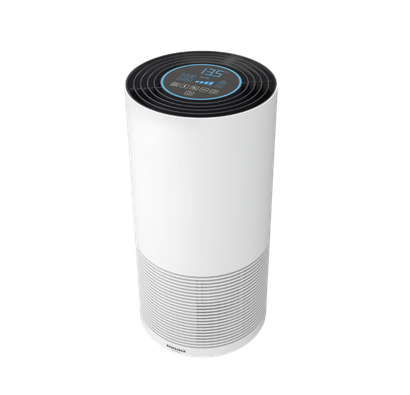
An air purifier is a machine designed to improve air quality in the home by filtering and cleaning the air of pollutants and other harmful substances. This can include dust, pollen, mould spores, smoke, and other airborne particles. Some air purifiers in the range can also help reduce odours with a built-in carbon filter.
Why use an air purifier?
An air purifier can contribute to a healthier indoor climate and may be especially relevant for people with allergies, asthma, or other breathing difficulties. It can also be useful in cities, where air pollution is often higher. By filtering harmful particles from the air, air purifiers can help reduce airborne particles and support better everyday comfort.
Is an air purifier the same as a dehumidifier?
No. An air purifier and a dehumidifier serve two different purposes. An air purifier cleans the air of pollutants, while a dehumidifier reduces and controls the moisture level in the air. If you are comparing products on this page, this is one of the most important differences to keep in mind.
For webshop browsing, many users begin by deciding whether their main concern is particles in the air or excess moisture in the room. That first step helps narrow the category quickly and makes product comparison more manageable.
Many homes benefit from a dehumidifier
The moisture balance in your home is an important factor for both your wellbeing and the condition of the house. High humidity can contribute to the growth of mould and dust mites, which may lead to allergies and other health issues.
If the challenge is too much moisture rather than particles in the air, a dehumidifier is the more relevant choice. This category brings both product types together, so it is easier to compare their roles before moving on to a more specific selection.
What is a dehumidifier?
A dehumidifier is an electric machine that helps control and reduce humidity in your home, creating a healthier and more comfortable environment.
How does a dehumidifier work?
Dehumidifiers draw humid air across cool surfaces, where the moisture condenses into water. The water is collected in a removable tank or drained away automatically if the dehumidifier has a drain option. The dry air is then circulated back into the room, helping to create a drier indoor climate.
How long should a dehumidifier run?
The ideal running time depends on the size of the room and the level of humidity. In the range, you will find several dehumidifiers with a hygrostat that switches off automatically when the desired humidity level has been reached. This can help support efficient operation.
When should you use a dehumidifier?
You may want to consider a dehumidifier if you notice damp areas in your home, condensation on windows, or if you want to avoid long-term damage caused by excess moisture. A dehumidifier for a basement or utility room is often a practical option, as these rooms often attract more moisture.
Humidity levels vary a lot throughout the year and also from one home to another. In some cases, the better solution is actually to add moisture rather than remove it. If that is what you need, you can explore humidifiers as an alternative within the same area.
Can you reuse water from a dehumidifier?
Water collected from a dehumidifier is not suitable for drinking, but it can be used for other purposes such as watering plants.
How this category helps you choose
When you shop for Air Purifiers & Dehumidifiers online, it often helps to move from the broad need to the specific product type. If your goal is to remove airborne particles such as dust, pollen, or smoke, air purifiers are the natural place to focus. If your main issue is dampness, condensation, or high humidity, dehumidifiers are more relevant.
This category is useful because it gathers both solutions in one place, making side-by-side comparison easier before you narrow your choice. If you are building a complete approach to indoor climate, you can continue browsing nearby categories. For cooling in warmer periods, see fans and air conditioning. For added warmth in colder months, explore heater fans and electric radiators.
Looking across related categories can make it easier to understand whether your home needs cleaner air, lower humidity, added moisture, cooling, or extra heat. That gives you a clearer path from general indoor climate concerns to the product type that fits your situation best.
Whether you start from a broad overview or from a specific need, this category is designed to help you compare the key functions of air purifiers and dehumidifiers in a simple and practical way.
Frequently asked questions
What is the difference between an air purifier and a dehumidifier?
An air purifier is designed to clean the air by filtering particles such as dust, pollen, mould spores and smoke. A dehumidifier is designed to reduce and control moisture in the air. In everyday use, this means an air purifier is more relevant for airborne particles, while a dehumidifier is more relevant for dampness and condensation.
How do I choose between an air purifier and a dehumidifier?
A practical starting point is to focus on the main issue in your home. If you want cleaner air because of particles or allergens, an air purifier is the better fit, while high humidity or condensation points towards a dehumidifier. This makes it easier to move from a broad indoor climate concern to a more specific selection.
What does an air purifier remove from the air?
An air purifier is designed to filter pollutants and airborne particles such as dust, pollen, mould spores and smoke. Some models can also help reduce odours by using a carbon filter. In practice, this helps you understand whether your concern is about air quality rather than humidity levels.
Who might benefit from using an air purifier?
An air purifier may be especially relevant for people with allergies, asthma or other breathing difficulties. It can also be useful in areas where air pollution is higher. In everyday use, this means it is often considered when the goal is to reduce particles in the air at home.
How does a dehumidifier work?
A dehumidifier draws humid air across cool surfaces so the moisture condenses into water. The water is then collected in a tank or drained away if there is a drain option, and the drier air is circulated back into the room. In practice, this helps you lower humidity and create a drier indoor climate.
How long should a dehumidifier run?
The running time depends on the size of the room and how humid it is. Some dehumidifiers have a hygrostat that switches the unit off automatically when the chosen humidity level is reached. This makes it easier to manage everyday use without having to monitor it constantly.
When should I consider using a dehumidifier?
A dehumidifier may be worth considering if you notice damp areas, condensation on windows or generally high humidity in the home. It is often a practical option for rooms such as basements or utility rooms, where moisture can build up more easily. In practice, this helps you match the product to places where excess moisture is the main issue.
Can water from a dehumidifier be reused?
Water collected from a dehumidifier is not suitable for drinking. It can, however, be reused for other purposes such as watering plants. This gives you a practical way to use the collected water while avoiding unsuitable uses.