Rice cookers for consistent results, simply and quickly
If you enjoy rice dishes but want to avoid burnt pans or uneven results, a rice cooker is a practical kitchen appliance to consider. It cooks rice evenly and helps you get consistent results while you focus on the rest of the meal. On this page, you can compare Rice Cookers by size and function, so it is easier to find a model that suits both your kitchen and the way you cook.
Rice cookers have long been a standard appliance in many Asian kitchens, where rice is often a central part of the meal. They are also widely used in Nordic homes, where many people enjoy cooking dishes from different cuisines and prefer appliances that combine function with a simple, timeless look.
More than rice: what a rice cooker can be used for
A rice cooker is not only for plain white rice. It is also useful when you want sushi rice, rice porridge or warm rice to serve with curry dishes and wok meals. For many shoppers, that is where this category becomes easier to explore. You can start with the type of meals you want to prepare most often, and then narrow your choice by size and included features.
Some rice cookers can also be used for quinoa, lentils and bulgur. Models with a steamer insert give you more flexibility, as they can also be used for vegetables and small dishes such as dumplings, gyoza or bao buns. If you are comparing options online, this is often one of the main differences to look at. Consider whether you only need a cooker for rice, or want a model that can handle a little more in everyday cooking.
Rice cookers can also be a flexible choice in smaller living spaces or places where you want a compact appliance that is easy to use. That is why many people look first at capacity, then at extras such as a glass lid or steamer insert, before deciding which model fits best.
How to choose the right rice cooker
If you have not used one before, choosing the right rice cooker can feel less straightforward than it seems. A practical way to choose is to begin with portion size. Once you know whether you mainly cook for one or two people or prepare larger amounts more often, it becomes much easier to compare the models in this category.
Choose by size
In this range, you can choose between a 1.5 litre rice cooker and a 1.8 litre rice cooker. The smaller size works well for 1 to 2 people and is a good match for smaller kitchens. The larger size is better suited to family cooking or larger portions, and it also gives you more flexibility if you want to use the steamer insert at the same time.
As a guide, a 1.5 litre model is suitable for around 2 to 3 people, while a 1.8 litre model can suit around 4 to 5 people. For most situations, this is the simplest way to move from browsing to choosing. Start with household size, then check whether the extra capacity would be useful for guests or larger meals.
Choose by features
Once you have found the right size, the next step is to compare the details that affect daily use. The rice cookers in this category are designed with a simple, timeless appearance that fits into most kitchens, and the practical features are easy to compare from product to product.
Features in this category include a ceramic non-stick bowl, a steamer insert, straightforward controls and a glass lid. In everyday use, these differences matter because they affect both cooking and cleaning. A ceramic non-stick bowl helps with cleaning after use, while a steamer insert is useful if you want to prepare vegetables or similar side dishes in the same appliance. Straightforward controls are helpful if you prefer an appliance with only a few settings, and a glass lid lets you follow the cooking process as it happens.
The ceramic non-stick coating is described as PFAS-free in this range. If that is important to you, it can be one more point to compare when looking through the available models.
Using a rice cooker in everyday cooking
A rice cooker is designed to make cooking simpler. You rinse the rice in a sieve or colander, add water, and start the machine. It cooks at a steady heat and stops when the water has been absorbed. After that, it switches automatically to keep warm. This is one of the reasons many people use a rice cooker regularly. You do not need to stir or keep checking the pot while the rice cooks.
As a general rule, use 1 part rice to 1.5 parts water. Sushi rice usually needs a little less water, while brown rice often needs a little more. Most rice is ready in 15 to 30 minutes, depending on the type and quantity.
Cleaning and care
Rice cookers are also relatively easy to clean. Wash the ceramic bowl with a soft sponge and avoid abrasive pads. Wipe the base of the machine with a damp cloth, and use wooden or plastic utensils to help protect the coating. It is also useful to store the lid and steamer insert dry.
Nordic Sense rice cookers
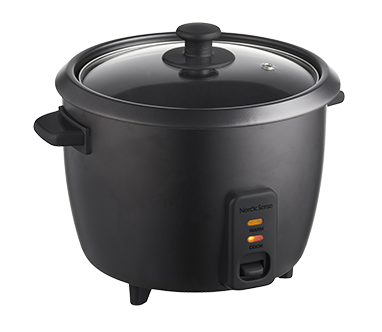
This category includes rice cookers from kitchen appliances brand Nordic Sense, which combines functionality with a clean Nordic design. The brand is known for user-friendly products with a simple look and a focus on everyday practicality.
In this category, Nordic Sense rice cookers are available in two sizes. The 1.5 litre model is a compact option for smaller portions, while the 1.8 litre version includes a steamer insert and is better suited to larger servings. If you are exploring the wider selection at Kitchenware, this makes the rice cooker category easy to compare with other appliances while still keeping the focus on a specific cooking task.
Common questions when comparing Rice Cookers
What is a rice cooker?
A rice cooker is an electric kitchen appliance that cooks rice automatically using steady heat. It boils away the water and switches off when the rice is done.
How does it work?
It cooks rice evenly and stops when the water has been absorbed, giving you consistent results without stirring during cooking.
What can you cook in it?
Besides rice, it can also be used for sushi rice, rice porridge, quinoa, lentils and bulgur. If the model has a steamer insert, it can also be used for vegetables and small steamed dishes.
Which model should you choose?
The best choice depends on your needs. If you usually cook for 1 to 2 people, a 1.5 litre model is often enough. If you need larger portions or want the added flexibility of steaming, a 1.8 litre model is the better fit.
Continue exploring kitchen appliances
If you are browsing this category as part of a broader kitchen update, you can also look at other appliance types depending on how you cook. Alongside Rice Cookers, the wider range includes airfryers, blenders and food processors, coffee machines, electric kettles, hand blenders and hand mixers.
You can also compare with more specialised appliances such as hot plates, ice cream machines, microwave and mini ovens, mini food processor, mixers and other electrical products.
For cooking styles that call for different appliances, you can also browse pizza ovens, raclette, sous vide, toasters and panini grills, toasters and waffle irons.
Frequently asked questions
How do I choose the right rice cooker size?
A practical way to choose is to start with how many people you usually cook for. A 1.5 litre rice cooker is generally suitable for around 2 to 3 people, while a 1.8 litre model can suit around 4 to 5 people. In everyday use, this means the larger size can be more useful if you often cook family meals or want extra room for larger portions.
What is the difference between a 1.5 litre and a 1.8 litre rice cooker?
The main difference is capacity, which affects how much you can cook at one time. The 1.5 litre model is a better fit for smaller kitchens and smaller portions, while the 1.8 litre model is better suited to larger servings and family cooking. In practice, this helps you choose based on both household size and how flexible you want the appliance to be.
What features are worth comparing when choosing a rice cooker?
The category content highlights features such as a ceramic non-stick bowl, a steamer insert, straightforward controls and a glass lid. These details matter because they affect both cooking and cleaning in daily use. This makes it easier to compare filtered choices by looking at whether you want simpler operation, easier cleaning or the option to steam side dishes as well.
Can a rice cooker be used for anything other than rice?
Yes, some rice cookers can also be used for sushi rice, rice porridge, quinoa, lentils and bulgur. Models with a steamer insert can also be used for vegetables and small steamed dishes such as dumplings, gyoza or bao buns. In everyday use, this means one appliance can help with more than just plain rice.
How does a rice cooker work in everyday cooking?
You rinse the rice, add water and start the machine, and it cooks at a steady heat until the water has been absorbed. After that, it switches automatically to keep warm. In practice, this helps you get consistent results without needing to stir the rice or keep checking the pot.
How much water should I use in a rice cooker?
As a general rule, use 1 part rice to 1.5 parts water. Sushi rice usually needs a little less water, while brown rice often needs a little more. This makes it easier to adjust the cooking to the type of rice you are preparing rather than using exactly the same ratio every time.
How long does rice take to cook in a rice cooker?
Most rice is ready in about 15 to 30 minutes, depending on the type and quantity. Brown rice can take longer than other types, while smaller amounts may cook more quickly. In everyday use, this gives you a rough guide for planning the rest of the meal.
How do you clean and care for a rice cooker?
Wash the ceramic bowl with a soft sponge and avoid abrasive pads, then wipe the base with a damp cloth. It is also advised to use wooden or plastic utensils and to store the lid and steamer insert dry. In practice, this helps protect the coating and makes regular cleaning simpler.